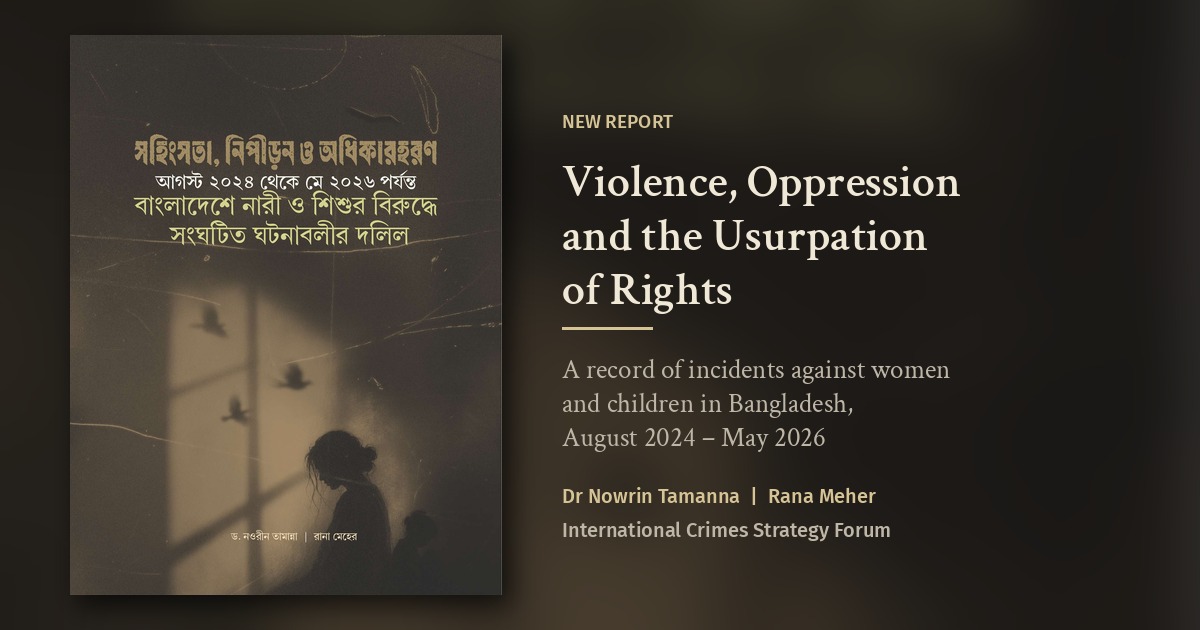
The International Crimes Strategy Forum (ICSF) is publishing a new report, Violence, Oppression and the Usurpation of Rights: A Record of Incidents Against Women and Children in Bangladesh, August 2024 to May 2026 (Sohingshota, Nipiron o Odhikarharon). The authors are Dr Nowrin Tamanna, a law academic at the University of Reading, and Rana Meher, a teacher and human rights activist.
The report is part of the documentation initiative ICSF announced in August 2024 to collect and preserve information and evidence of violations committed in Bangladesh.
The report covers the period from the political changeover of August 2024 to May 2026. It draws on incidents reported in the national media and by human rights organisations. Within each chapter, incidents are listed month by month, and each entry keeps the original date of publication and the name of the source. Readers can therefore check every incident against the original report.
What the report covers
The report is organised around five areas:
- Rape, gang rape, murder following rape, and other sexual violence
- Violence against girls
- Violence against women from minority communities
- Mob culture, moral policing and public harassment of women
- Attacks, cases and harassment against pro-1971 women and women linked to the Awami League
Key findings
- The situation changed in kind after August 2024. The authors say that women’s safety, children’s protection and civil rights have steadily worsened. They point to more incidents, but also to how widespread and brutal the violence has been and how rarely anyone has been held to account.
- Children are among the worst affected. A large share of the victims documented are children and adolescent girls, some as young as three, five or seven. In many cases the accused were neighbours, relatives, teachers or religious teachers rather than strangers.
- Women from minority communities and politically targeted women face particular risks. The report documents violence against religious minority women. It also documents arrests, cases and harassment against women identified with the values of 1971 or with the Awami League, including former MPs and political activists.
- Mob rule and moral policing have spread. Public humiliation and assaults on women in the name of “morality” have become, in the authors’ words, a means of social and political control that takes the place of the rule of law.
- There has been no meaningful improvement after the change of government. The report finds that the impunity and insecurity that took hold under Dr Muhammad Yunus’s unelected, unconstitutional interim administration have continued since the BNP-led government took office in February 2026, and in some respects have deepened.
- Violence is not only physical. Fear, social exclusion, political reprisal, silencing, and exclusion from education, work and public life are also forms of violence.
The authors argue that how a state treats its most vulnerable citizens is the real test of its justice, democracy and humanity. They also argue that the safety of women, children and minorities is bound up with the spirit of the 1971 Liberation War and the founding principles of the Constitution of Bangladesh (1972). In their words, the report is “not merely a record of past events; it is an urgent warning.”
About this edition
This is the abridged edition, published by ICSF in November 2026. A fuller book with further analysis of the findings and the material collected is in preparation.
The report is in Bangla.
[Download the full report (PDF)]
Content note: the report contains detailed accounts of sexual violence, including against children.
Copyright © ICSF, Dr Nowrin Tamanna and Rana Meher. The report may not be reproduced in whole or in part without prior written permission.